Mux Engineering Retrospective: The Data-Driven Evolution of Basic Video Encoding Ladders and the Decision to Keep 270p

Video streaming infrastructure provider Mux has published a comprehensive engineering retrospective detailing the evolution of its basic video encoding ladder, highlighting the complex data-science decisions behind its latest configuration update. The overhaul, which introduced a 720p tier while preserving the ultra-low 270p resolution, demonstrates how modern video delivery networks must balance storage costs, network bandwidth, content delivery network (CDN) cache efficiency, human viewer experience, and the rapidly growing non-human audience of automated artificial intelligence agents.

The journey of the basic encoding tier began several years ago with the introduction of a deliberately sparse three-rung configuration consisting of 270p, 480p, and 1080p. While this sparse design was chosen intentionally to minimize storage footprints, reduce cache fragmentation, and simplify client-side adaptation logic, it created notable usability gaps. Viewers restricted by mobile bandwidth caps, rural network constraints, or small device display windows faced an awkward dilemma: dropping down to 270p could feel excessively soft, while overreaching for 1080p risked catastrophic rebuffering events. By omitting a middle ground, Mux engineers recognized that a significant segment of mid-tier users was being underserved.
The Balancing Act of Reductions and Additions
When Mux engineers initially evaluated ways to improve the basic tier, the most straightforward proposal was to maintain a three-rung structure by dropping the lowest 270p tier and replacing it with a 720p layer, resulting in a 480p, 720p, and 1080p ladder. Pre-deployment configurations were prepared on the assumption that eliminating the smallest rendition would streamline server-side workloads and simplify caching operations across global CDNs.
However, user feedback and evolving technological trends quickly complicated this simple fix. Data analysis revealed a surprising array of active use cases for ultra-low-resolution video, ranging from mobile picture-in-picture windows and commuters traversing intermittent rural coverage areas to a brand-new, fast-growing class of video consumers: artificial intelligence agents and automated processing robots. Because modern computer vision models performing automated tagging, scene detection, content moderation, and algorithmic summarization require only a fraction of the pixel data that human eyes demand, high-resolution streams represent an unnecessary computational expense for machine consumers. Eliminating the 270p tier would have forced these automated systems onto more expensive 480p streams without delivering any analytical benefit.
To resolve the debate without relying on speculation, Mux’s infrastructure team leveraged a combination of deep data logging and an internally constructed Encoding Ladder Decision Tool. By auditing extensive CDN storage, compute logs, and quality-of-experience metrics drawn from Mux Data over a multi-week observational window in early 2026, the team modeled the exact financial and performance implications of altering the rendition ladder.
Analyzing CDN Cache Efficiency and Cost Projections
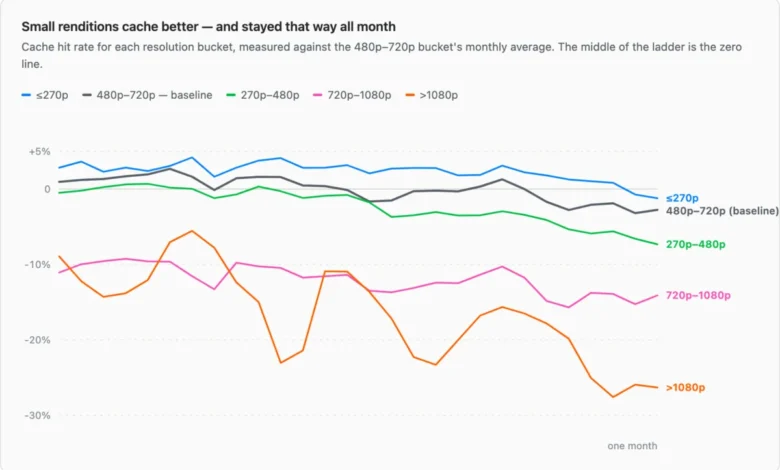
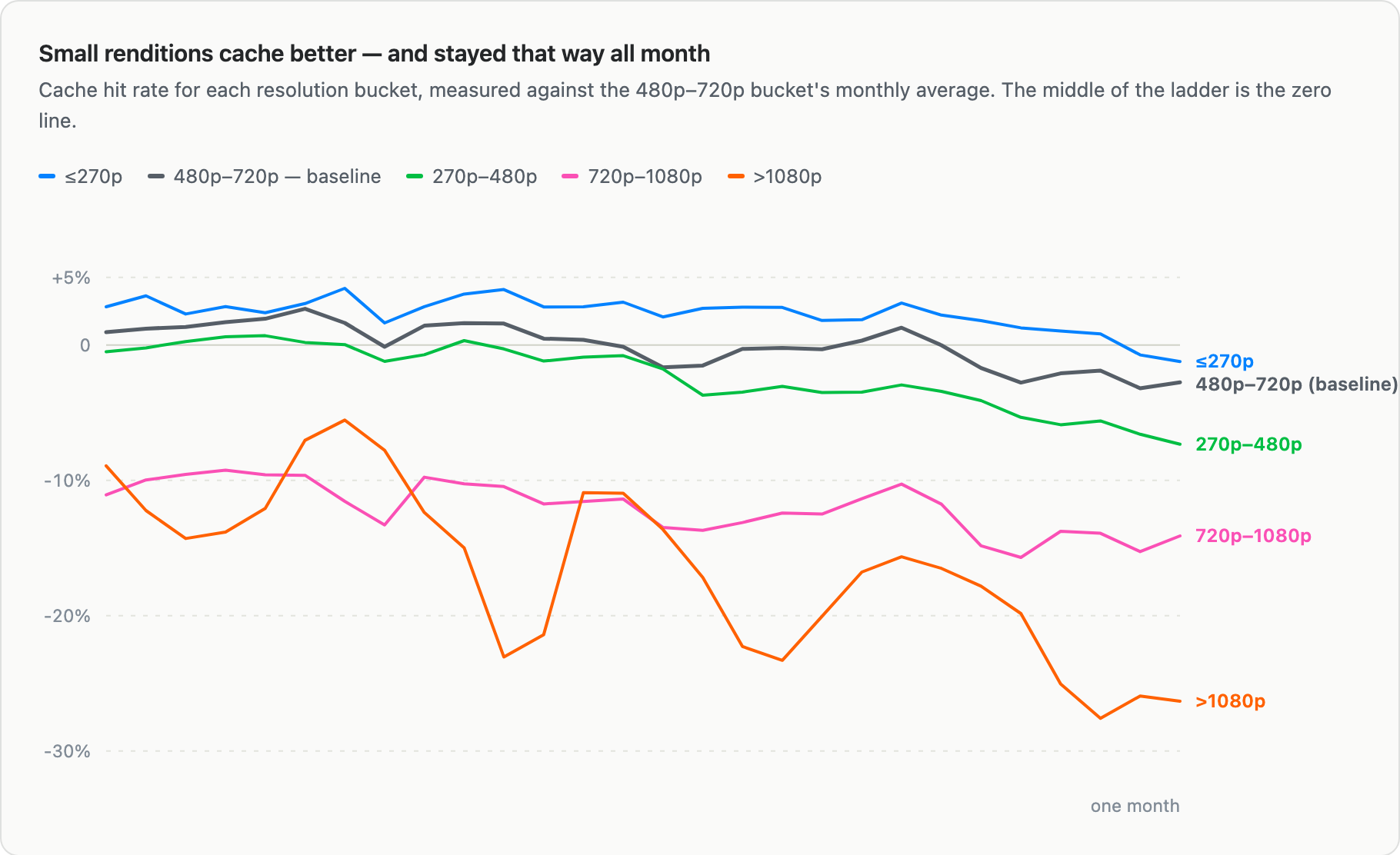
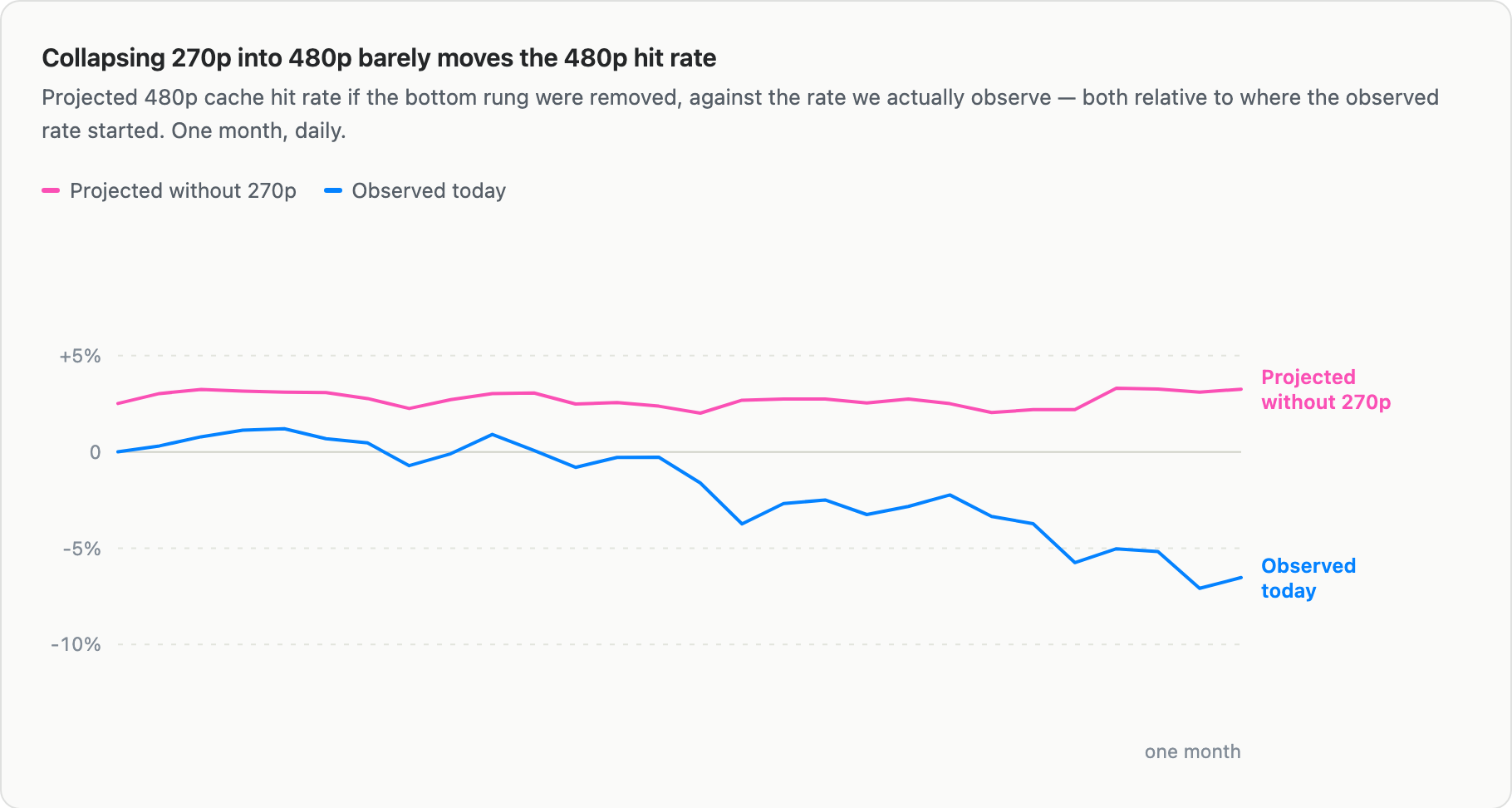
A primary hypothesis investigated during the study was whether collapsing the 270p tier into 480p would significantly boost cache hit rates by reducing the total number of distinct objects competing for edge cache space. Empirical analysis of real-world traffic, however, disproved this assumption. While consolidating renditions marginally increased request frequency against surviving objects, the resulting gains in cache efficiency were negligible and highly variable, occasionally threatening to break even at best and increase origin-fetch overhead at worst.
Simultaneously, cost modeling showed that simply removing 270p would force a large volume of mobile and constrained views up to the 480p tier, approximately doubling the bitrate and subsequently driving up storage and delivery expenses. Consequently, Mux made the definitive operational decision to preserve 270p as a safety net while officially expanding the basic ladder to four rungs: 270p, 480p, 720p, and 1080p.
Phased Rollout and Performance Metrics
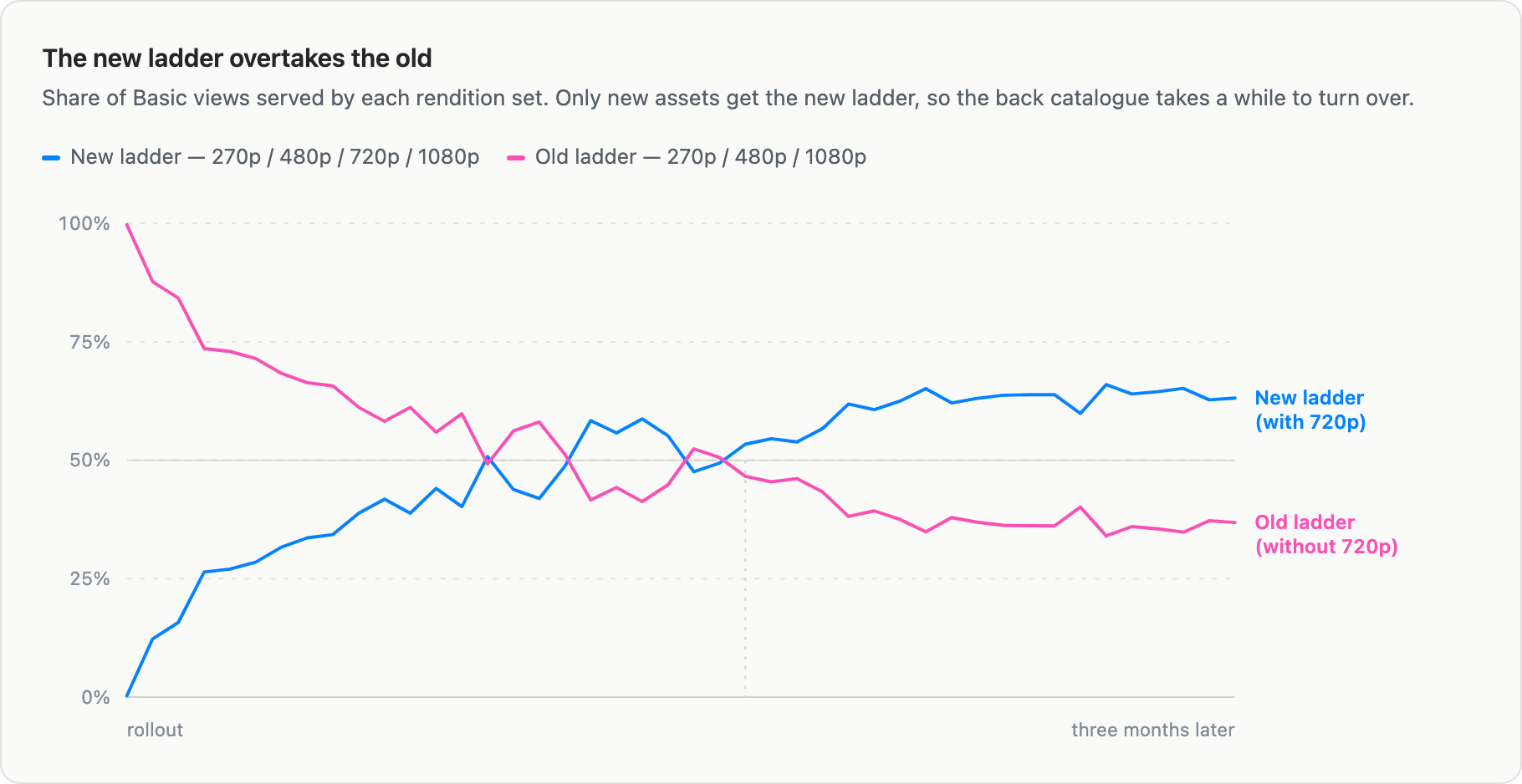
The newly optimized basic encoding ladder was deployed gradually beginning in April 2026, utilizing feature flags to monitor incoming telemetry and mitigate stability risks. Because Mux manages a massive historical back-catalog of archived content, the updated rendition set applied primarily to newly ingested video assets, creating a natural adoption curve that required over a month to establish dominance across total viewing minutes.
Post-rollout telemetry gathered across a three-month comparative window highlighted dramatic shifts in viewing patterns and technical performance:
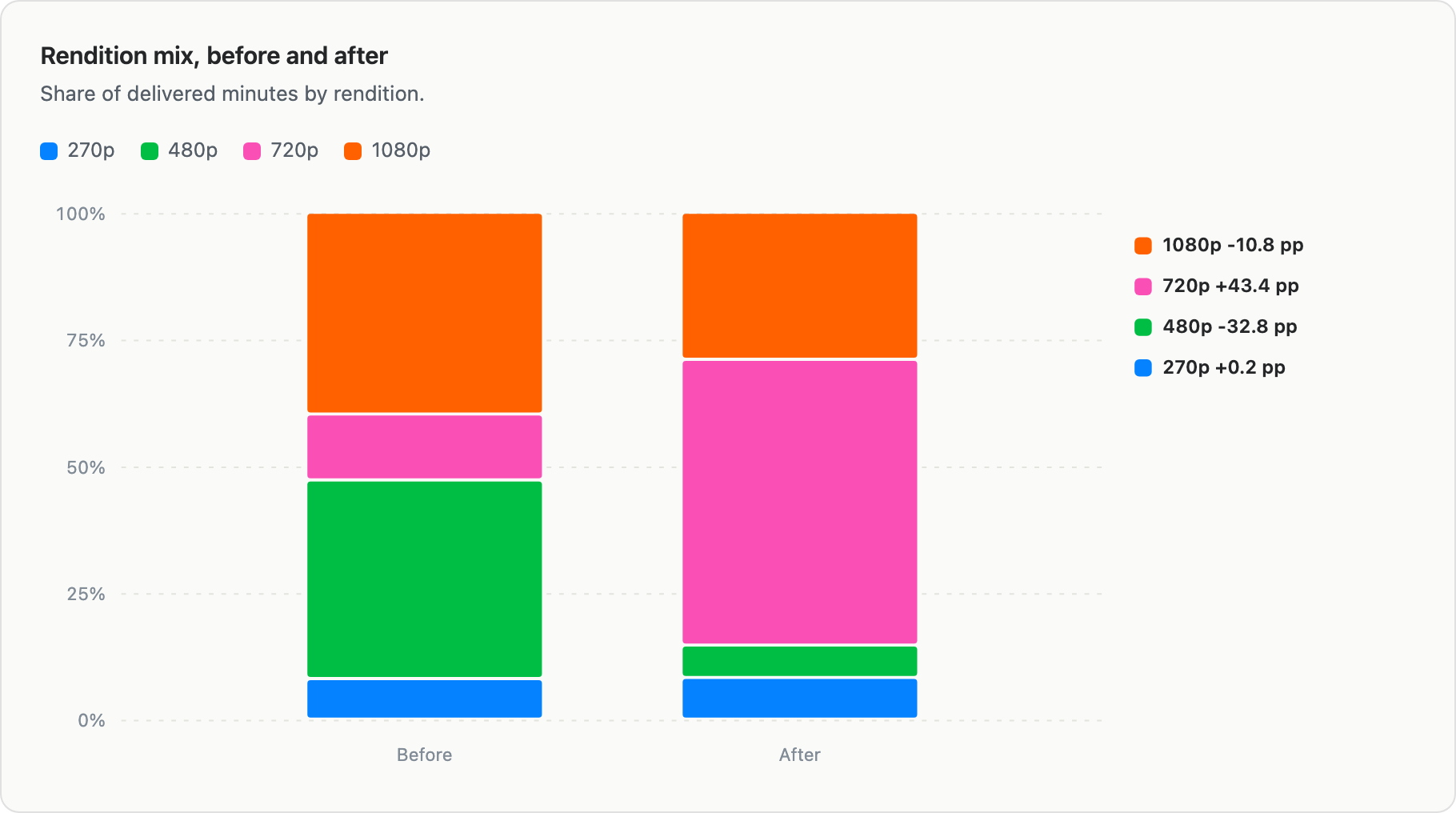
- Massive Adoption of the Middle Tier: Delivered minutes on the 720p tier skyrocketed from approximately 10% to roughly 50% of all basic assets. This increase drew traffic from both directions, causing 480p consumption to collapse from one-third of total minutes into the single digits, while 1080p usage experienced a measurable decline as players settled into the optimal middle ground.
- Preservation of the Low-End Safety Net: Consumption of the 270p tier remained virtually flat, confirming that the low-end safety net continues to serve its specific demographic of constrained human users and automated AI agents without unnecessary bloat.
- Modest Increase in Bandwidth Consumption: Delivering the enhanced ladder resulted in an overall 6.5% increase in bytes per minute. Although moving viewers from 480p to 720p raised delivery volumes, this increase was partially offset by a 4.8 percentage point reduction achieved through concurrent optimizations in Per-Title Encoding (PTE) algorithms, which fine-tuned bitrates without degrading visual fidelity.
- Measurable Gains in Video Quality: Using Mux Data tracking, the new four-rung ladder consistently maintained a superior Video Quality Score—averaging approximately 99.7 compared to 99.1 for the legacy ladder. Furthermore, the median delivered bitrate experienced by viewers increased as more users landed on the optimal middle resolution.
- Zero Latency Penalty: Engineering teams anticipated that larger 720p file segments might introduce startup delays or increase seek latency. Instead, empirical logs revealed that seek latency remained flat, while video startup latency actually improved due to parallel network stack enhancements, such as advanced CDN selection protocols operating within millisecond thresholds.
Financial Implications and Industry Significance
From a commercial perspective, the architectural shift produced an unusual financial outcome for customers. Because Mux prices video delivery based on tiered resolutions—with 720p representing a more economical delivery tier than 1080p due to its smaller pixel count—the migration of viewers toward 720p lowered overall invoice costs for customers even while total data delivery volumes increased slightly.
Industry analysts observe that this engineering achievement aligns infrastructure incentives directly with user performance. By resisting the temptation to implement simplistic tier reductions and instead utilizing rigorous data science to preserve specialized low-end rungs, Mux has demonstrated how modern video platforms can simultaneously improve user experience, accommodate automated machine consumers, and optimize delivery economics in an increasingly data-dense digital landscape.
Related posts: